



Table of Content
Hardside vs Softside Carry-On: Which Should You Choose

Choose hardside carry-on luggage when protection and fixed dimensions matter most. Choose softside carry-on luggage when you need quick access and more packing flexibility.
For travelers buying one cabin suitcase for work trips or short vacations, the decision should start with what goes inside the bag. Airline fit comes before color or styling. The shell type then determines how the case opens, stores items, and responds when fully packed.
How Hardside and Softside Carry-On Luggage Differ
Both types can work well in the cabin, but they organize and protect packed items differently. A hard shell keeps a fixed outline, while a fabric case can flex around its contents. This structural difference affects access, packing space, cleaning, and airline compliance.
|
Buying factor |
Hardside carry-on |
Softside carry-on |
|
Crush protection |
Rigid exterior spreads pressure across the shell |
Fabric moves under pressure |
|
Packing layout |
Usually opens into two sections |
Often uses one deep compartment |
|
Outside access |
Uncommon unless a front pocket is added |
Common on many designs |
|
Packed size |
More predictable |
May grow when pockets are filled |
|
Expansion |
Available on some models |
Common on many models |
|
Cleaning |
Shell usually wipes clean |
Fabric may require spot cleaning |
|
Home storage |
Requires a fixed amount of space |
May compress for easier storage |
|
Visible wear |
Scratches can show on smooth shells |
Fabric can show stains or abrasion |
Hardside Carry-On Luggage Holds a Fixed Shape
Hardside cases are commonly made from polypropylene, polycarbonate, ABS, or aluminum. Polycarbonate can flex under impact and return toward its original shape. ABS is usually used in lower-priced cases, while aluminum provides a firm structure with more weight.
A rigid exterior helps prevent the packed case from bulging beyond its listed shape. It also provides a firm barrier around shoes, electronics, and other items that should not be compressed. The shell still has limits. Force can reach the contents through the case, and fragile items need cushioning near the center.
Softside Carry-On Luggage Uses Flexible Fabric
Softside cases normally use woven nylon or polyester over a light supporting structure. The fabric can flex around clothing and other soft items, which makes the packing space more forgiving.
Front pockets give travelers access to documents or a laptop without opening the main compartment. A single deep packing area can also hold thick clothing more easily than two shallow clamshell sections.
Flexibility creates a sizing risk. A full front pocket or open expansion zipper can push the packed case beyond the airline limit even when the empty suitcase meets it.
Carry-On Luggage Opens in Different Ways
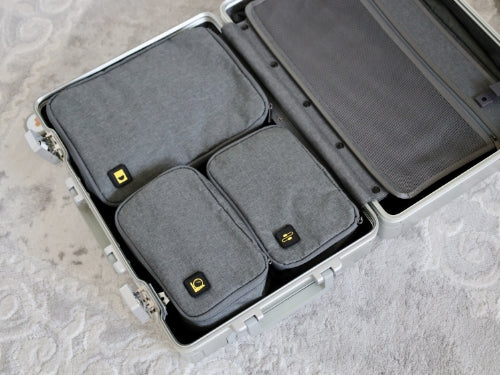
Most hard cases use a clamshell opening with packed items on both sides. This layout separates the load and works well with dividers or compression panels. It needs enough floor or bed space to open both halves.
A traditional softside case usually has a lid over one main compartment. It can be easier to open on a luggage rack because the lower section stays in place. This layout also suits bulky clothing that does not divide neatly between two halves.
Which Carry-On Luggage Fits Airline Size Rules
Airlines measure the complete packed bag. Wheels and fixed handles count, while an overfilled soft pocket can increase the final depth.
Some shopping menus use the phrase baggage carry for cabin luggage. The category name does not confirm compliance. Always compare the complete exterior measurements with the operating airline’s policy.
Current U.S. Carry-On Luggage Size Examples
These dimensions were checked against official airline pages on October 13, 2026.
|
Airline |
Published carry-on maximum |
Important detail |
|
American Airlines |
22 × 14 × 9 inches |
Handles and wheels are included |
|
Delta Air Lines |
22 × 14 × 9 inches |
Total cannot exceed 45 linear inches |
|
Southwest Airlines |
24 × 16 × 10 inches |
One carry-on and one smaller personal item are allowed |
Measure Carry-On Luggage After Packing
Lower the telescoping handle and stand the packed suitcase on a hard surface. Measure the greatest height, width, and depth. Include wheels, side feet, fixed handles, and filled exterior pockets. Check each measurement separately. A suitcase measuring half an inch under the height limit cannot use that unused space to offset excess depth.
Expansion Changes Softside Carry-On Dimensions
An expansion zipper adds useful capacity, but the expanded case may no longer qualify as a carry-on. Close the expansion before measuring the bag for a flight.
Soft walls do not guarantee acceptance. A case that can be squeezed by hand may still fail to enter a fixed airport sizer when tightly packed.
A hard case is easier to measure because the exterior does not grow with the load. Its published dimensions must still include the wheels and handles.

Does Hardside or Softside Carry-On Luggage Last Longer
Neither construction has a fixed service life. Material quality and component design make a larger difference than the broad category. When comparing luggage, inspect the parts that move or carry weight. A strong shell provides little value if a wheel mount or telescoping handle fails early.
Hardside Carry-On Luggage Wear
Polycarbonate can flex under pressure, while ABS tends to be more rigid and may be more likely to show stress after repeated hard impacts. Aluminum does not flex like plastic and can develop visible dents.
Smooth shells often show scratches. A textured finish or darker color can make normal cosmetic wear less noticeable.
A hard shell protects against broad pressure, but corners and closure points still need reinforcement. Check how the wheels attach to the case and whether the zipper or frame closes smoothly when the suitcase is loaded.
Softside Carry-On Luggage Wear
Fabric avoids shell cracking and usually hides minor surface marks. Abrasion can weaken exposed corners, seams, or areas near the wheel housing.
Inspect the fabric after several trips. Loose threads, worn piping, or stretched seams can show where the load is placing too much pressure.
Water Resistance Depends on the Whole Case
A plastic shell sheds surface water well, but water can still enter through a zipper or joint. A fabric coating may resist light rain, while seams remain possible entry points. Treat both types as water resistant only when the manufacturer makes that claim.
How to Choose Hardside vs Softside Carry-On Luggage
Start with the item that is hardest to pack. A laptop may require fast access, while thick clothing may need a flexible compartment.
Then check the airlines used most often. A feature has little value if its added pocket or expansion prevents the case from meeting the required dimensions.
Choose Hardside Carry-On Luggage for Protected Tech Access
A standard hardside case often makes a traveler open the full clamshell to reach a laptop. That is inconvenient at security and can expose packed clothing.
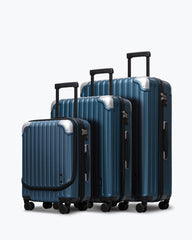
The Road Runner Carry-On 20-inch addresses this problem with a front section for a 17-inch laptop and a 10.9-inch tablet. Its Makrolon polycarbonate shell provides a firm exterior, while separate locks protect the front section and main compartment. It holds 38 liters and weighs 9.5 pounds. Its listed dimensions are 21.7 × 14.5 × 9.6 inches, including the handle and wheels.
Choose Softside Carry-On Luggage for Flexible Capacity
Travelers who return with more than they packed may need controlled expansion. Exterior pockets also keep a laptop and smaller items available during transit.
The Capture Carry-On 20-inch uses 1680D nylon and includes a front pocket for a laptop up to 15.6 inches. The case weighs 8.4 pounds and measures 22.8 × 15 × 9.25 inches before considering any additional expansion. Its expansion zipper increases stated capacity from 40 to 46 liters, providing six additional liters when airline limits permit.
Consider Luggage Sets Only When Trip Length Changes
A single carry-on works for frequent short trips. Longer travel may require a checked suitcase with a different capacity.
Coordinated luggage sets can make sense when both sizes will be used regularly. Check every case separately because the carry-on still needs to meet airline limits.
Buying one size first allows you to test the handle height and packing layout. It also shows whether the brand’s wheels remain stable under your normal load.
FAQs
Can an airline gate-check a carry-on that meets the size limit?
Yes. Limited overhead space can require gate checking, especially on regional aircraft or full flights. Keep medication, batteries, and important documents in a removable personal item.
Is a softside carry-on always lighter?
No. Weight depends on the frame, wheels, pockets, and fabric. Compare published empty weights for specific models instead of relying on the shell category.
Can a hard carry-on protect glass items?
Partly. A rigid shell reduces outside compression, but glass still needs padding. Place fragile items near the center and keep them away from the shell.
Should a power bank stay inside a gate-checked carry-on?
No. Remove it before handing over the bag. The FAA advises passengers to keep spare lithium batteries and power banks in the cabin.
Do airlines prefer hard or soft carry-on luggage?
No. Airlines focus on dimensions, stowage, and safety. Either type can be accepted when the fully packed bag meets the operating carrier’s rules.
Conclusion
The hardside vs softside carry-on decision depends mainly on structure and access. Choose hardside luggage for a fixed outline and stronger resistance to compression. Choose softside luggage when exterior pockets and flexible packing provide more value.
Measure the fully packed suitcase before every flight. A well-designed carry-on only works when its complete exterior fits the airline’s current limit.
Leave a comment