



Everything You Need to Know About Carry On Luggage

Carry on luggage works best when it fits your airline and keeps every essential within reach. Most large US airlines use 22 × 14 × 9 inches as a common maximum, though each carrier sets its own rule. Your fare, route, and aircraft can also change what you may bring onboard. Check the operating airline before every trip.
What Counts as Carry On Luggage
A carry on is the larger bag that normally goes in the overhead bin. It may be a wheeled suitcase, travel backpack, or duffel, as long as it meets the airline’s size rule and your fare includes it.
A personal item must fit fully under the seat in front of you. A purse or compact backpack often qualifies. Your carry on receives a larger allowance.
What Size and Weight Carry On Luggage Is Allowed
There is no universal carry on size or weight. The 22 × 14 × 9 inch format is common among major US carriers, while Southwest permits a larger case. Comparing the latest carry on luggage specifications for airlines is always reliable.
Every measurement below refers to the complete exterior, including fixed wheels and handles. The weight column reflects the general policy published by each airline, though certain routes and aircraft may have additional restrictions.
|
Airline |
Maximum carry on size |
General weight policy |
|
American Airlines |
22 × 14 × 9 in |
No general cabin weight limit listed |
|
Delta Air Lines |
22 × 14 × 9 in and 45 linear inches |
No general limit on most routes |
|
JetBlue |
22 × 14 × 9 in |
No general cabin weight limit listed |
|
Alaska Airlines |
22 × 14 × 9 in |
Passenger must be able to lift the bag |
|
Southwest Airlines |
24 × 16 × 10 in |
No general cabin weight limit listed |
Measure the Complete Bag Before Leaving Home
Place the packed carry on luggage upright on a hard floor. Measure from the floor to the highest point, then measure the widest and deepest points. Include the wheels, side handle, front pocket, and anything attached outside. A flexible pocket also counts when it is filled.
Calculate How Much Packing Weight Remains
The empty weight of the suitcase counts toward an airline’s allowance. A 9-pound case leaves 13 pounds for clothing and other belongings when the carrier applies a 22-pound limit.
Weigh the fully packed case at home. Keep a small margin because home scales may differ from airport equipment. Limits of 15 to 22 pounds are common, but the exact allowance depends on the airline and fare.
Check Every Flight on a Connecting Itinerary
The smallest allowance on the itinerary should control your luggage choice. A case accepted on the first flight may exceed the dimensions or weight limit of a connecting airline.
Codeshare flights require extra attention. Check the baggage rules of the airline operating the aircraft rather than relying only on the company that sold the ticket.

What Can You Pack and How Should You Pack Carry On Luggage
TSA controls checkpoint screening in the United States, while airlines control bag size and cabin acceptance. Pack restricted items according to TSA and FAA rules, then organize the remaining space by weight and access.
|
Item |
Current US cabin rule |
|
Liquids, gels, creams, pastes, and aerosols |
Each container may hold no more than 3.4 oz or 100 mL. All containers must fit in one quart-size bag |
|
Medically necessary liquids |
Larger quantities may be allowed after separate screening |
|
Power banks and spare lithium-ion batteries up to 100 Wh |
Carry in the cabin and protect against short circuit |
|
Spare lithium-ion batteries from 101 to 160 Wh |
Airline approval is required, and the limit is two |
|
Spare lithium-ion batteries over 160 Wh |
Not allowed on passenger aircraft except specific mobility-device provisions |
Keep Liquids and Medication Near the Opening
Transfer the product into a container marked 3.4 ounces or less, then place it with the other covered items in the quart-size bag. Keep the liquids bag near the top of the suitcase so it can be removed without disturbing your clothing.
Medication receives separate treatment. Tell the officer about medically necessary liquids before screening and keep them easy to remove.
Pack Batteries Where You Can Reach Them
Power banks and spare lithium batteries must stay in the cabin. Cover exposed terminals or place each battery in a protective pouch so metal objects cannot create a short circuit.
Do not bury these items beneath packed clothing. If an agent gate-checks your suitcase, you must remove the power bank and spare batteries before handing over the bag.
Place Heavy Items Near the Wheels
Shoes and tightly sealed toiletry containers belong near the wheel end of a rolling case. This position helps the suitcase remain stable when it stands upright and reduces pressure on lighter clothing.
Fill unused shoe space with socks or charging cables stored in a pouch. Place lighter clothing above the dense items, then use the compression panel or internal straps to reduce movement.
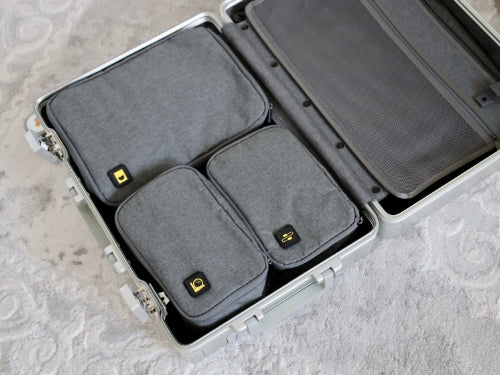
Packing cubes can separate clean clothing from laundry. They improve organization and compress soft items.
Build the Clothing List Around the Trip
List the activities planned for the trip before choosing outfits. Rewear neutral bottoms and change the layer closest to the skin. One compact pair of shoes can save more space than compressing several shirts. For longer trips, washable quick-dry clothing makes one bag travel more practical.
How Should You Choose Carry On Luggage
Start with the strictest airline you use regularly. Compare the complete case dimensions, empty weight, opening style, and usable interior.
The right construction depends on how you travel and where the case will be stored. A rigid suitcase, soft bag, or collapsible luggage design can serve different needs even when the exterior dimensions are similar.
Choose the Shell and Wheels for Your Travel Pattern
-
Polycarbonate hardshell cases give packed items a firm outer barrier and resist light rain.
-
Softside cases can provide exterior pockets and slight flexibility.
-
Collapsible designs take up less storage space at home and may work for car or train trips. They provide less structure around fragile items and can lose their shape when packed unevenly.
-
Four spinner wheels move easily in terminals and narrow lines.
-
Two-wheel cases usually provide more recessed wheel protection.
Keep Work Devices Accessible During Transit
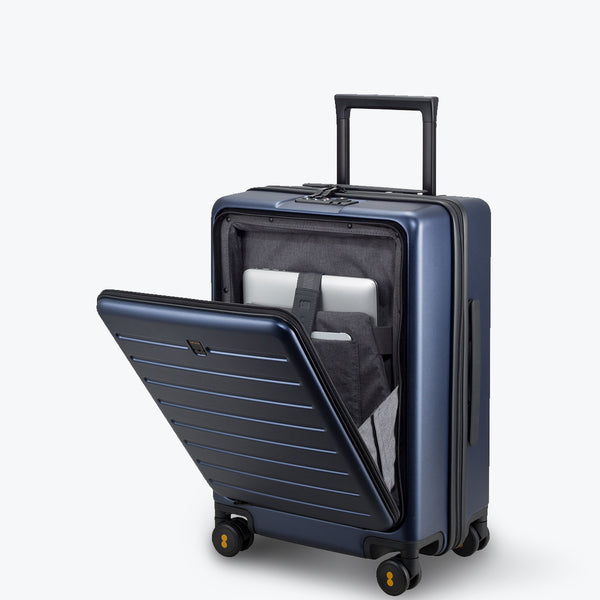
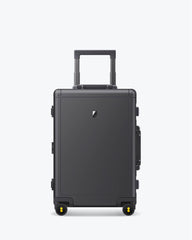
A laptop buried under clothing slows security checks and makes gate-area work difficult. A protected front compartment solves that access problem while keeping the device separate from shoes and toiletries. The Road Runner Carry-On 20-inch has sleeves for a 17-inch laptop and 10.9-inch tablet. Its 38-liter interior, polycarbonate shell, and dual locks support a three-to-five-day work trip.
Match the Opening Style to the Space You Use
A clamshell suitcase opens into two halves and makes categories easy to separate. It needs enough floor or bed space for both sides. A front-lid design opens from one side and keeps the packing area smaller.
Travelers who often use compact hotel rooms may find top opening carry on luggage easier to access. The main compartment can be packed from one side without spreading the entire suitcase across the floor.
Decide Whether Expansion Is Worth the Extra Depth
Expandable carry on luggage provides extra room through a secondary zipper around the case. The feature can help when packing for mixed weather or bringing purchases home. Many carry on expandable luggage models exceed airline depth limits after the expansion zipper is opened. Measure the expanded case before using that space on a flight.
The Adventure Carry-On 20-inch addresses limited room space with a top-opening layout and wide handle that leaves a flatter main compartment. It holds 45 liters and adds 5 liters when expanded. Its 21.3 × 15.4 × 10.2 inch exterior suits carriers with a larger allowance, including Southwest.
Expandable luggage can still be useful when the zipper remains closed during the flight. The additional space can be opened after landing for a road trip or used when the suitcase is checked on the return journey.

FAQs
Can food go in carry on luggage?
Yes, solid food is generally allowed. Liquid or gel food over 3.4 ounces usually cannot pass the checkpoint unless an exemption applies. TSA may ask you to separate food for screening.
Are smart suitcases allowed on planes?
Usually, when the battery is removable. Airlines may reject a smart bag with a lithium battery that cannot be removed. Check the carrier’s policy before departure.
Does duty-free liquid count under the TSA limit?
It may qualify for an exception. Keep international duty-free liquid in its secure tamper-evident bag with the receipt. TSA applies extra conditions to connecting passengers.
Can nail clippers go in a carry on?
Yes, TSA generally allows nail clippers. The officer at the checkpoint has final authority, and any sharp item should be packed so it cannot injure someone.
Can a carry on be used for a week?
Yes, with a controlled packing list. Rewear outer layers, limit footwear, and plan laundry. Climate and trip purpose matter more than the number of days alone.
The Final Carry On Check
The right carry on fits the strictest flight on your itinerary while remaining light enough to lift. Measure the packed exterior and confirm both the size and weight allowance before leaving home.
Separate liquids and batteries for easier screening. Choose the opening style and expansion feature only after confirming that the complete suitcase meets the operating airline’s rules.


Leave a comment